
ANONYMIZED CASE STUDY
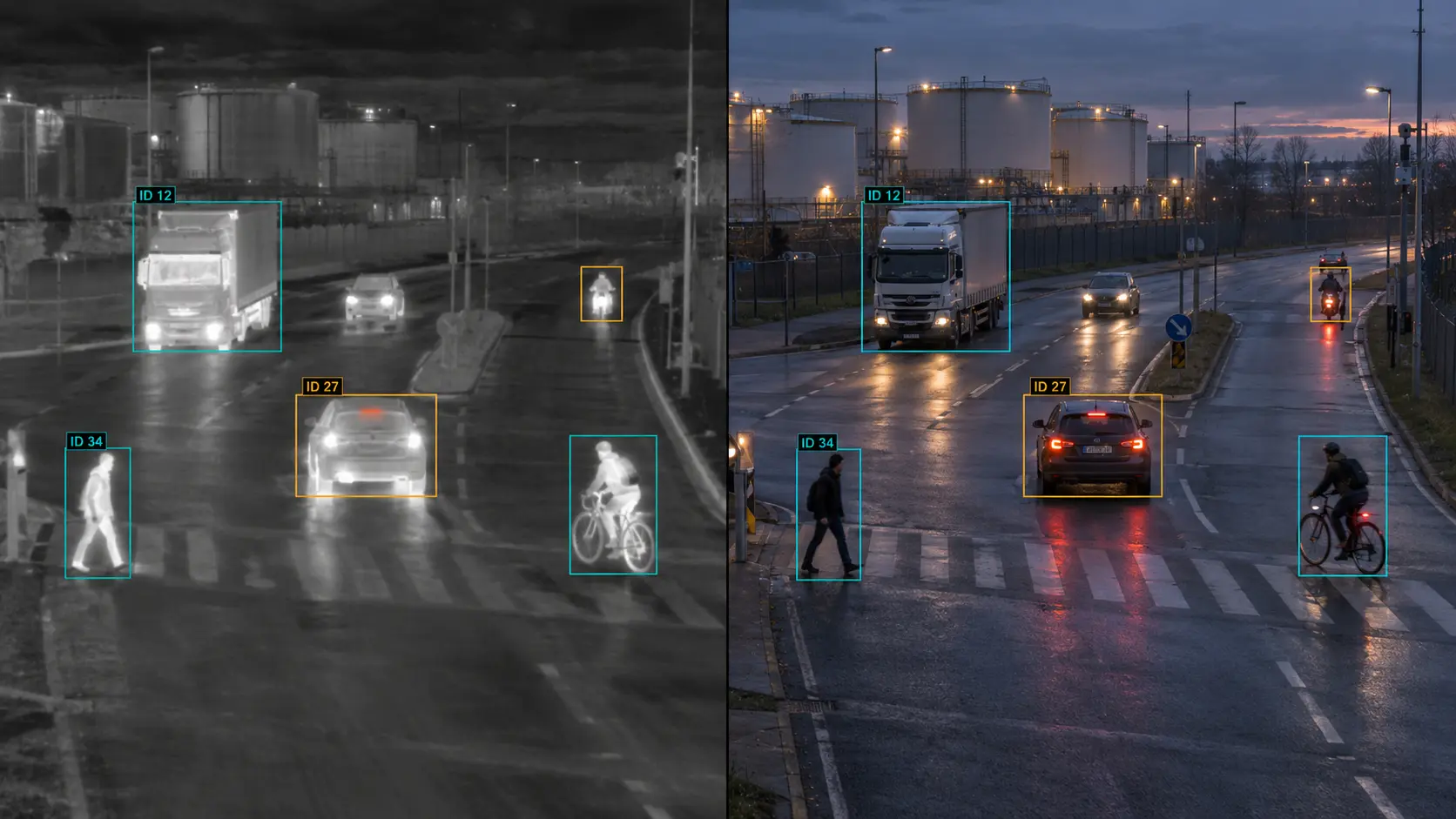
Thermal and RGB Video Tracking for Security AI
Every-frame bounding-box tracking across more than 230 hours of thermal and RGB video for a Belgium-based European security and intelligent-traffic technology company.
Project context
Aimage Annotators supports an ongoing, anonymized video-annotation program for a Belgium-based European security and intelligent-traffic technology company. The work draws on Hema Sekhar's more than 15 years of computer-vision annotation experience with this long-running client program. The figures below cover completed, reviewed and delivered work recorded during 2026.
Annotation challenge
Thermal and RGB footage from European roads, tunnels, ports, intersections, industrial sites, storage facilities and other security environments required consistent object identities through long sequences. Every source frame had to be inspected, and every visible bounding box had to be adjusted manually rather than accepted through automatic interpolation.
Data and task
- More than 230 hours of delivered thermal and RGB video
- More than 23 million source frames, including frames without target objects
- Approximately 146,000 unique tracked objects
- Person, car, truck, bus, bicycle, motorcycle, animal and unattended-object classes
- Sometimes-synchronized thermal and RGB views, plus independent camera recordings
Workflow
- Applied the client's established class and visibility rules in a customized annotation platform
- Created tight bounding boxes and persistent Track IDs for visible target objects
- Inspected every frame and manually adjusted each visible box
- Kept the same Track ID through temporary occlusion and partial visibility
- Ended a track when an object completely left the field of view; a later re-entry was treated as a new object
- Manually inspected and skipped frames containing no target objects
Important edge cases
- Darkness and low thermal contrast
- Very small or partially visible targets
- Crowded scenes and overlapping objects
- Fast movement and abrupt scale changes
- Camera vibration, camera shake and changing viewpoints
- Weather and other climatic conditions
Quality assurance
- A separate reviewer inspects every frame in every completed video
- Bounding-box fit, object class and Track-ID continuity are checked
- Errors are returned to the annotator for correction
- Corrected work is reviewed again before final delivery
- Exported files are validated for expected video data, Track IDs and structural completeness
Delivery outputs
- Client-specific, JSON-like annotation files
- Persistent Track-ID data aligned to the delivered videos or assigned frame ranges
- Validated exports delivered after annotation, correction and re-review
Outcome
The workflow has supported intrusion detection, traffic monitoring, incident detection, unattended-object detection and pedestrian-safety applications. Completed 2026 batches were fully reviewed and delivered without double-counting split annotation ranges.
This case study is intentionally anonymized. No client names, confidential source images or unsupported performance claims are included.